

The Common Learning Middleware (CLM) supports the development of sustainable, modular, and interoperable learning infrastructures in numerous reference projects. The goal is to connect existing learning platforms, content, and services in a way that ensures they remain operable and scalable in the long term while staying independent of individual systems or vendors.
From the outset, a central design principle of CLM has been the consistent pursuit of interoperability. Open standards and clearly defined interfaces form the foundation not only for functionally integrating learning ecosystems but also for making them future proof.
Learning Analytics and AI as a Logical Evolution
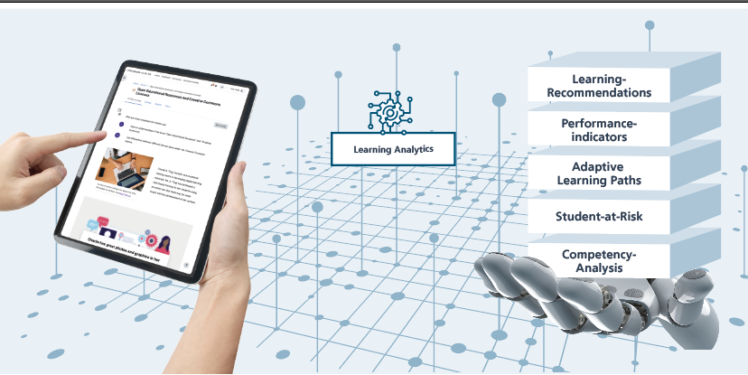
With the growing importance of learning analytics, data driven feedback mechanisms, and the use of AI supported methods such as Large Language Models, the focus is increasingly shifting from individual learning applications to the question of how learning data can be made usable across systems.
To achieve this goal, extending the CLM with the functionality of a Learning Record Store (LRS) is a logical step. The LRS enables learning experiences from different systems to be captured in a structured manner, validated, and made available as a shared data foundation.
The extension complies with the ADL Experience API (xAPI) as well as the IEEE Experience API (IEEE 9274.1.1-2024) and was designed from the outset for decentralized, sovereign, and federated setups. The LRS is not intended as an isolated component, but as an integral part of the CLM.
Technical Principle: Interoperable, Data-Efficient, Data Protection Compliant
The CLM based LRS follows a clear architectural approach. Learning data is collected decentrally and can be consolidated and evaluated in a controlled manner via the CLM, including across organizational and system boundaries.
xAPI profiles serve as a binding access and data contract. They enable the validation, filtering, and targeted pooling of statements and thereby create semantic interoperability.
An integrated data preparation and aggregation service provides protected, pre aggregated metadata. This enables rapid analysis without requiring access to raw data.
Privacy by Design is a central principle of the architecture. Identities are processed pseudonymously, and sensitive metadata is not stored permanently. Resolution or enrichment takes place, if required, in a controlled manner at runtime.
The resulting data efficient learning records serve not only analytical purposes but can also be used for the delivery and personalization of learning content.
Outlook
With the addition of LRS functionalities, the Common Learning Middleware is being consistently further developed. It evolves from an integration layer into a data driven foundation for learning analytics and AI within interoperable learning infrastructures.
Ongoing trials in various contexts, ranging from research studies and international educational institutions to large scale governmental learning environments, are continuously incorporated into the further development of CLM and help to refine the vision of a robust and interoperable learning infrastructure.